photo by Paulo Pereira
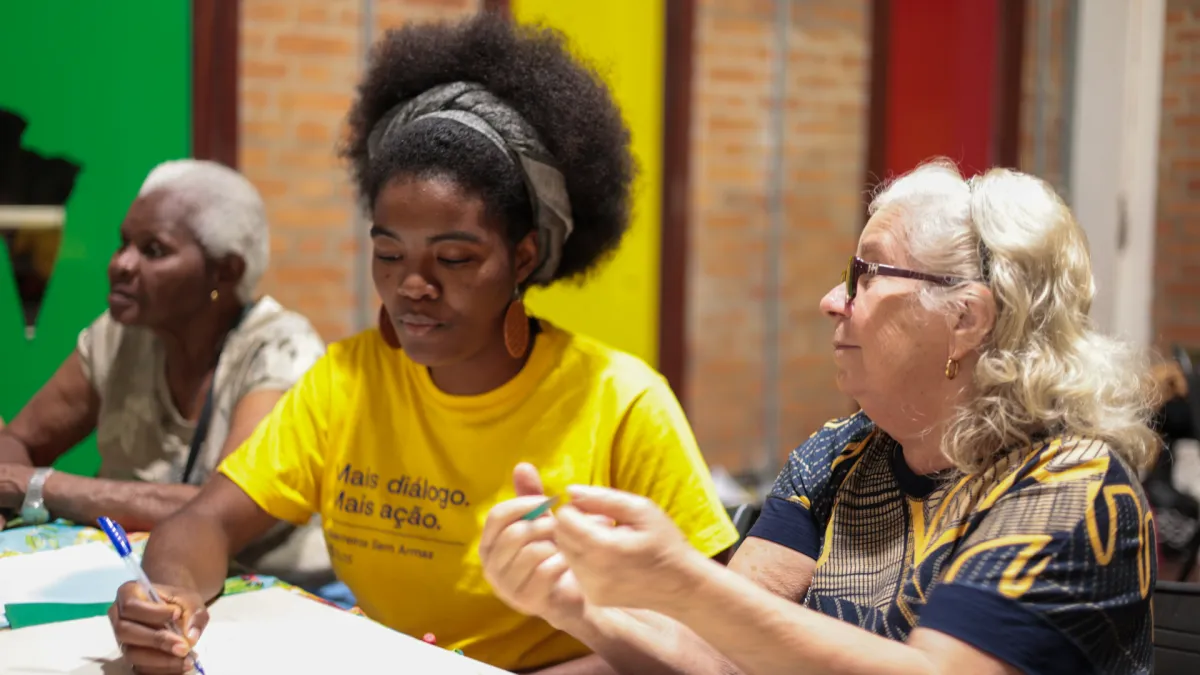
A project has an end date. The bond between the people who have been part of it does not, and Elos remains at the heart of it. It is through this bond that what works in one place finds its way to another.
Networks within the Elos Methodology
The project cycle comes to an end.
Not the support.
The communities continue to exist, to communicate with one another and to grow stronger.
In early 2026, fires returned to the Vila Gilda Embankment. Within a few weeks, the blaze had destroyed homes on more than one occasion, and the forecast of intense heat heightened fears of further losses.
The solution the neighbourhood came up with wasn’t thought up on the spot. In Jardim São Manoel, also in Santos, residents were already using a similar warning system. The two communities are part of the same network, and it was through this that one neighbourhood’s solution reached the other: two sirens at high vantage points, residents trained as emergency responders, and equipment purchased through a community fundraising campaign.
Elos is part of this network. When the project comes to an end, what changes is our role: we stop taking the lead and start supporting, presenting, unblocking and connecting one end to the other.
That’s what a network does. It brings together those who need to find a solution with those who have already done so.
How a network is formed
You can’t set up a network in a day.
It is built in three stages, each of which depends on the previous one. It is the same process in any area where Elos operates.
- 01
Recognising and coordinating
Before any work begins, the community identifies what it already has: leaders, initiatives, organisations, spaces and resources. From this identification emerges an agenda that people have built together, rather than a list of demands.
- 02
Collectively implementing and sustaining
The agenda becomes a reality. Grassroots organisations gain the capacity to plan, manage, raise funds and implement projects, and the initiatives now have people to take responsibility for them after the collective effort.
- 03
Participating and making an impact
The local community is now taking its place at the tables where its future is decided: councils, conferences, forums and calls for proposals. It is here that the network ceases to depend on Elos and begins to secure resources and shape policies on its own.
The map of exchanges
Every line here is one community teaching another.
- Jardim São ManoelSantos, SPA community fire alarm system2026Dique da Vila GildaSantos, SP
- SantosBrazilThe whole methodology, and a school that still runs on it today2010BissauGuinea-Bissau
- PaquetáSantos, SPLocal young people at the World Social Forum, and two on an exchange2006Canadaexchange
- GuarujáSPA facilitator, taking the Oasis Game to another continent2022KatlehongSouth Africa
- CubatãoSPA multiplier who came back to open the door for other young people2023 to 2025His own generationBaixada Santista
- Jardim São ManoelSantos, SPA community garden that became a national benchmark2025The countrynational recognition
A case in 2020
When everything shut down, the internet was the only option left.
During the pandemic, Elos had no staff in nine regions of the country. We knew people in each of them from previous projects. It was these local leaders who told us who needed what, and it was through them that the aid reached them.
Tupinambás of Olivençasouthern Bahia
Chief Ramon
23 villages. They have requested food, hygiene supplies, a community vegetable garden and a water cistern.
Caiçaras, Guarani and QuilombolasVale do Ribeira, SP
Dauro Prado
Traditional communities across four municipalities. They have requested food and a community vegetable garden.
Manchineri PeopleAcre
Lucas Brasil Manchineri
They asked for a vegetable garden, a shopping voucher for use within the community itself, and transport.
Parque das Tribos and MauésAmazonas
Arnaldo and Ítalo
Thirty-five ethnic groups in a settlement in Manaus, and a riverside municipality 267 km away.
LençóisChapada Diamantina, BA
Líllian Pacheco
Forty Quilombola women entrepreneurs. They requested supplies and infrastructure to maintain the online shop they set up themselves.
Abaeté, Bassoli and SiriusCampinas, SP
Vera, Reginaldo and Marcelo
Three residential homes where Elos had worked for two years. They asked for food and a shopping voucher.
Dom BoscoJuiz de Fora, MG
Renato, from the NGO ABAN
A community with its roots in the quilombo tradition. They mapped the urgent needs of 500 families living at the top of the hill.
Recanto da PazAracaju, SE
Lenildo Bayer
A rural community under pressure from property development. They asked for food and a shopping voucher.
Nas Quebradas 013Baixada Santista, SP
Samara, Joice and Rose
Seventeen communities in Santos, Cubatão and Guarujá, mapped one by one.
Nine territories, seven states, 7,234 households surveyed. None of them were part of an Elos project at that time.
R$ 583,000
donated and used in the Baixada Santista region
9,155
people assisted, from 1,831 households
17
communities in the Baixada region reached
68.8 tonnes
food collected and distributed
Rede Elos Presentation, 2020 · these four figures relate to the operation in the Baixada Santista region
The invitation
Would your community like to work with Elos?
There’s no need to sign up to a network, and you don’t need a CV. Just tell us where you live, who’s already meeting up in your area, and what the local community is trying to tackle. We’ll get back to you.